
 Respira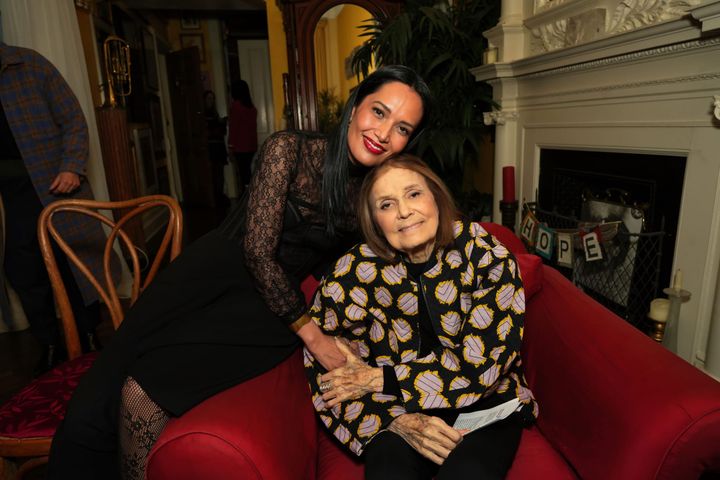
Por Bea Gasca*

There are some women whose lives become history.
And then there are women who change the way history is written.
Gloria Steinem was one of those women.
On September 2, 2026, Gloria Steinem died peacefully at her home in New York City at the age of 92, surrounded by people who loved her. She leaves behind not simply an extraordinary body of work, but something much harder to measure: a generation of women who learned to believe that their voices mattered.
I was fortunate enough to experience Gloria not only as the icon the world knew, but as a woman sitting across from me in her living room, then she became my mentor and then, my friend.
Earlier this year, we gathered there for an intimate talking circle.
The invitation described her living room as “a place where conversations become movements.”
I now understand just how true those words were.
The power of a room.
There was something almost radical about the simplicity of that gathering.
No stage. No grand auditorium. No distance between the person whose name had become synonymous with the modern women’s movement and the women sitting beside her.
Just a circle.
And conversation.
That was, in many ways, Gloria’s genius.
She understood that movements are not born only in legislatures, on television screens, or at enormous demonstrations. They begin when one person speaks honestly and another person realizes: I am not alone.
Gloria spent more than five decades doing exactly that—writing, organizing, speaking, challenging institutions and creating spaces in which women could see themselves as agents of change. As a journalist, co-founder of Ms. magazine, organizer and activist, she became one of the defining voices of second-wave feminism. She helped build organizations including the National Women’s Political Caucus and the Women’s Media Center, while remaining engaged with younger generations throughout her life.
But perhaps her greatest contribution was not any single organization or publication.
It was permission.
Permission to question.
Permission to refuse the roles assigned to us.
Permission to be complicated.Permission to lead.
And permission to keep going.
“Empathy is the most radical of human emotions.”
That sentence by Gloria has stayed with me.It feels especially important now.
We live in a world increasingly organized around division, speed, outrage and certainty. Gloria offered something different: curiosity. Listening. The willingness to sit with another human being long enough to understand what lies beneath the surface.
This is also where her legacy unexpectedly meets the philosophy behind Womanpalooza.
Womanpalooza speaks about women who perceive emotions intensely, who possess what it calls a “radar tuned to invisible dynamics that others cannot see.” It speaks about emotional intelligence not as weakness, but as a form of leadership.
That idea feels profoundly relevant to Gloria’s life.
She understood that changing the world requires more than winning arguments. It requires understanding people.
It requires recognizing the humanity behind the issue.
And it requires creating spaces where people can reason together.
“When unique voices are united in a common cause, they make history.”
Gloria lived that sentence.
She did not build her legacy by standing alone.
She built it by bringing people together.
Women from different generations. Different races. Different backgrounds. Different political and personal experiences.
Her feminism was ultimately about something larger than women alone. It was about human freedom—the possibility that our identities should not determine the size of our dreams, the boundaries of our lives or the opportunities available to us.
As she said in one of her most enduring formulations:
“A feminist is anyone who recognizes the equality and full humanity of women and men.”
That word—humanity—may be the key to understanding her legacy.
Because Gloria never seemed interested merely in giving women a larger place within an existing system.
She wanted us to imagine a better system.
In her historic 1971 address at the founding of the National Women’s Political Caucus, she declared that the goal was not simply reform, but a transformation of society—ending with the words, “We are really talking about humanism.”
The courage to be uncomfortable.
Gloria also understood something that every generation of changemakers eventually discovers:
Progress rarely arrives without resistance.
The invitation to our gathering at her home spoke about women who had “refused to remain silent” and who continued showing up despite criticism and backlash.
That could have been written about Gloria herself.
She was criticized. Dismissed. Mocked. Underestimated.
She kept going.
Her journalism exposed the exploitation of women. Her activism challenged entrenched political and social structures. She advocated for reproductive freedom, equality and women’s political participation. She continued speaking out long after many people would have considered retirement appropriate.
Her life reminds us that resistance is not necessarily evidence that we are wrong.
Sometimes, it is evidence that we have touched something that needs to change.
What comes after an icon?
This is the question Gloria herself would have wanted us to ask.
Not How do we replace her?We cannot.
The better question is:
What will we do with what she gave us?
Womanpalooza describes today’s challenge this way:
“The world needs us.”
And perhaps that is the most important lesson of Gloria’s passing.
The work does not end because one extraordinary woman is gone.
It becomes ours.
The next generation must carry forward the courage to question. The discipline to listen. The willingness to cross boundaries. The insistence that women’s experiences belong in the center of conversations about the future—not at the margins.
And perhaps, above all, we must preserve the spaces where people can sit together and reason.
Because Gloria believed in conversation.She believed in community.
She believed in organizing.
She believed that ordinary people, when connected by a common purpose, could create extraordinary change.
Her official biography describes decades spent traveling, organizing and lecturing across countries and boundaries, advocating for equality, peace and justice.
But sitting beside her in her living room, what struck me most was not the magnitude of her accomplishments.
It was her humanity.
The woman behind the movement.
The woman who still made room for conversation.
The woman who understood that a circle can sometimes be more powerful than a stage.
A legacy that does not belong to one woman.
Gloria once said:
“We’ll never solve the feminization of power until we solve the masculinity of wealth.”
She understood that equality could not be reduced to representation. It required changing the structures that determine who has power, who has resources and whose voice is considered valuable.
That work remains unfinished.
But so does the possibility.
Today, millions of women stand on ground that Gloria helped clear.
Women who vote.
Women who lead companies and governments.
Women who speak publicly about violence, discrimination and reproductive freedom.
Women who refuse to apologize for ambition.
Women who mentor younger women.Women who organize.
Women who write.
Women who gather in circles.
And women who, perhaps without realizing it, are living lives that would have been much harder to imagine without the path she helped create.
That is a legacy.
Not a monument.
Not a statue.
A living inheritance.
The circle continues.
When I look at the photograph of Gloria and me together, I don’t see an ending.
I see a handoff.
One generation beside another.
One woman whose life’s work opened doors beside women who must now decide what to build through them.
Gloria’s death leaves an enormous absence.
But perhaps the most fitting way to honor her is not to fill that absence with another icon.
It is to fill it with action.
To keep gathering.
To keep asking difficult questions.
To keep listening to women whose voices have not yet been heard.
To bring generations together.
To recognize emotional intelligence as a source of strength.
To reason together.
And to have the courage to walk into the world as our fullest selves.
Gloria Steinem spent her life reminding us that change begins when people refuse to accept that the world must remain as it is.
Now the circle belongs to us.
And the conversation continues.
May we be worthy of carrying it forward.
*Bea Gasca. Founder of Womanpalooza and Gloria’s Foundation Ally.
Las opiniones expresadas son responsabilidad de sus autoras y son absolutamente independientes a la postura y línea editorial de Opinión 51.



Comments ()